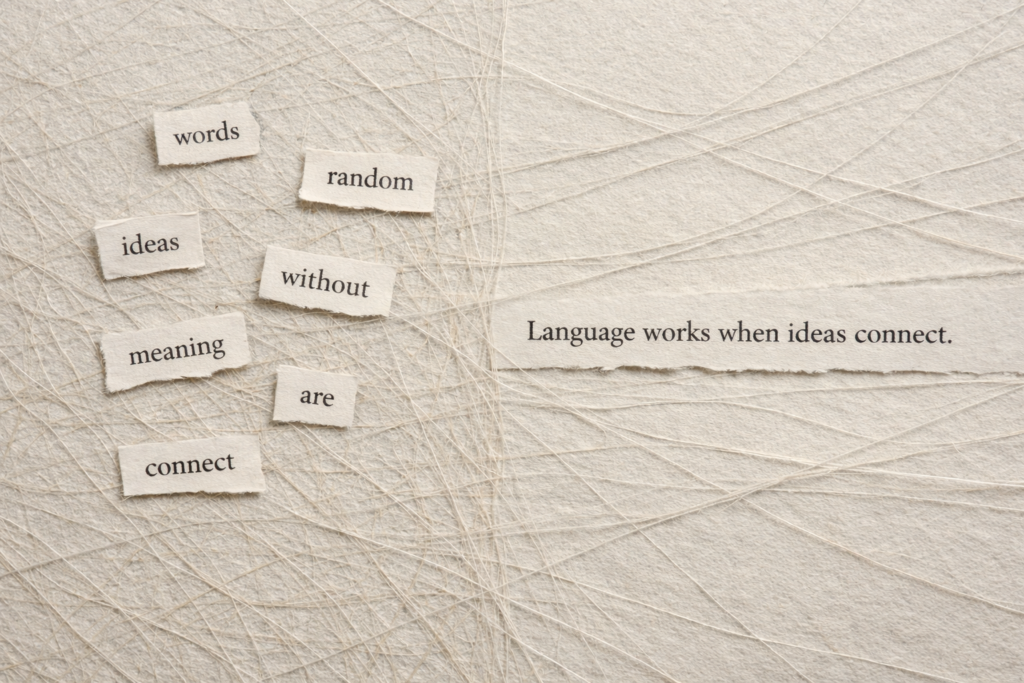
Most parents hear the word pragmatics and think it means manners, politeness, or social skills. That is not what it actually is. Pragmatics is how language is used to think, organize ideas, and understand what matters. Without it, language breaks down, even when a child knows vocabulary, speaks in sentences, or can read words on a page (Adams, 2024).
The “Friendly” Misconception
This can be true even when a child appears social, friendly, empathetic, and likable, and even when they have friends. Pragmatic language weaknesses do not mean a child is rude, antisocial, or disconnected from others. Instead, they reflect a struggle with how language is organized and used for meaning (Hage et al, 2021).
Prioritization and Organization
Pragmatics is how a child figures out what information is important, what can be skipped, and how ideas connect. It is the “prioritization engine” of the brain. When pragmatics are weak, language feels confusing and effortful. The child may hear the words but not grasp the point. Language does not “click” because there is no clear structure holding it together—a deficit often linked to executive function within the language system (Shokrkon & Nicoladis, 2022).
Impact on Spoken Language
This affects everyday spoken language first. Children with pragmatic weaknesses often struggle to explain themselves clearly or retell events. They may:
- Talk in circles.
- Provide “information dumps” without a main point.
- Give too little information for the listener to follow.
This is not a behavior problem; it is a language organization problem known as a breakdown in narrative macrostructure (Andreou & Lemoni, 2025).
Listening and Reading Comprehension
Understanding language requires knowing what the speaker means, not just what they say. When pragmatics are weak, directions feel overwhelming and feedback feels confusing.
Reading is impacted for the same reason. Reading is not just decoding; it requires understanding “theory of mind”, what characters are thinking and why they act (Duke, Ward, & Pearson, 2021). A child with pragmatic weaknesses may read accurately but miss the message entirely because the language is not being organized meaningfully in real-time.
The Link to Fluency and Writing
- Fluency: Fluent reading depends on grouping words by meaning (prosody). When language organization is weak, reading sounds robotic because the reader doesn’t “see” the thought groups within the sentence (Putnam & Erickson, 2024).
- Writing: Writing requires anticipating what a reader needs to know. Children with pragmatic difficulties often write vague or repetitive sentences. They may know the facts but cannot structure the “flow” of the argument (Troia, 2011).
Even Decoding is Affected
Words that are well-understood in spoken language are easier to recognize in print. When oral language is poorly organized or “fragile,” decoding remains effortful because the brain has no solid semantic anchor to attach the word to (Snowling & Hulme, 2025).
Conclusion
In simple terms, pragmatics is the glue. It connects words to meaning, meaning to thinking, and thinking to learning. When that glue is weak, language falls apart across speaking, listening, reading, and writing. Pragmatic language therapy is not an “add-on” for social skills; it is the foundation that allows language to work at all!
Pragmatics: Manners vs. Meaning
| The Common Misconception (Manners/Social Skills) | The Clinical Reality (Linguistic Organization) |
| “Please” and “Thank You”: Using polite words and following social etiquette. | Information Prioritization: Knowing which details are “the point” and which are “extra.” |
| Eye Contact: Looking at a person while they are speaking. | Monitoring Relevance: Keeping a conversation or story on track without “looping” or drifting. |
| Wait Your Turn: Not interrupting others when they talk. | Topic Maintenance: Understanding how one sentence connects to the next logically. |
| Sharing: Taking turns with toys or activities. | Audience Awareness: Judging how much background info a listener needs to understand a story. |
| Friendliness: Being likable, empathetic, and having a group of friends. | Inferencing: Reading between the lines to understand a speaker’s actual intent or “the big idea.” |
Is it time for a closer look?
If your child struggles to organize their thoughts, even if they are the friendliest kid in class, they may have a pragmatic language disorder. Because these challenges sit at the intersection of thinking and talking, they are best evaluated by a professional who understands the “architecture” of language.
References
- Andreou, G., & Lemoni, G. (2025). Narrative skills of children with developmental language disorder: Retelling in macrostructure. Frontiers in Education, 10, 1626433.
- Adams, C. (2024). Social Communication Intervention: Helping Children with Pragmatic Language Needs. Routledge.
- Duke, N. K., Ward, A. E., & Pearson, P. D. (2021). The science of reading comprehension instruction. The Reading Teacher, 74(6), 663–672.
- Hage, S. V. R., Sawasaki, L. Y., Hyter, Y., & Fernandes, F. D. M. (2022). Social communication and pragmatic skills of children with autism spectrum disorder and developmental language disorder. CoDAS, 34(2), e20210075.
- Putnam, O. C., & Erickson, K. A. (2024). The role of prosody in reading comprehension for individuals on the autism spectrum. Perspectives of the ASHA Special Interest Groups, 9(2), 297–307.
- Shokrkon, A., & Nicoladis, E. (2022). The directionality of the relationship between executive functions and language skills: A literature review. Frontiers in Psychology, 13, 848696.
- Snowling, M. J., & Hulme, C. (2025). The reading is language model: A theoretical framework for language and reading development and intervention. Annual Review of Developmental Psychology, 7, 195–218.
- Troia, G. A. (2011). How might pragmatic language skills affect the written expression of students with language learning disabilities? Topics in Language Disorders, 31(1), 40–53.