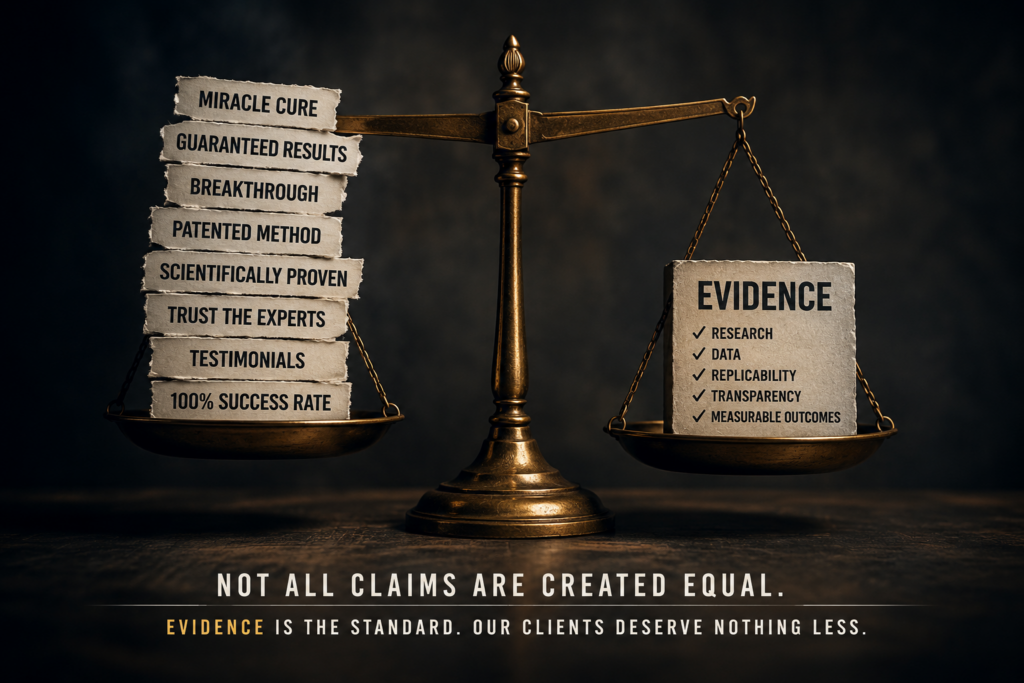
Abstract: In speech-language pathology, unsupported clinical claims often appear credible because they are attached to emotional testimonials, neuroscience language, parent urgency, professional trainings, or popular social media trends. This article provides a structured way to examine those claims without dismissing families, clinicians, or innovation. It reviews common red flags in pseudoscientific marketing, explains why “evidence-based” is often misused, and offers practical appraisal questions for determining whether a method is clinically defensible, measurable, and appropriate for a specific client.
I recently presented a webinar for The Hanen Centre titled Beyond the Buzzwords: Spotting Pseudoscience and Staying Evidence-Aligned. The presentation was extremely well received and generated substantial discussion regarding the rapid spread of unsupported or weakly supported clinical claims in speech-language pathology. Because the webinar itself and the distributed materials are now part of Hanen’s hosted professional development content, I am not reproducing that presentation here. Instead, this article offers a distinct but related discussion for my own professional audience, with an emphasis on clinical reasoning, evidence appraisal, ethical service delivery, and practical tools for evaluating questionable claims.
The need for this discussion is urgent. Speech-language pathologists are increasingly exposed to clinical claims through professional social media, parent advocacy spaces, commercial trainings, conference presentations, district initiatives, and continuing education offerings. Some of these claims are well supported. Others are plausible but preliminary. Still others are marketed with a degree of certainty that substantially exceeds the available evidence. In day-to-day practice, clinicians are often asked to respond quickly to programs, products, treatment models, and diagnostic labels that are already circulating among families, educators, and colleagues.
This article is not an argument against clinical innovation. New ideas are necessary in any applied discipline. However, innovation must not be confused with evidence. A method can be popular, hopeful, affirming, emotionally compelling, and well-intentioned while still lacking adequate support for the claims being made. The ethical responsibility of the clinician is not to reject every new idea, but to determine whether the strength of the evidence is proportionate to the strength of the claim.
Pseudoscience as an Evidence Problem, Not a Personal Attack
In clinical practice, the term pseudoscience is often misunderstood as a personal insult. It is not. Describing a claim as pseudoscientific does not mean that every clinician who has used the method acted in bad faith, nor does it mean that every family who pursued the method was foolish or uninformed. Most clinicians and families are attempting to solve real problems under conditions of urgency, limited time, and emotional pressure.
Pseudoscience refers to a mismatch between the scientific appearance of a claim and the actual evidence supporting that claim. Finn, Bothe, and Bramlett (2005) described pseudoscientific practices in communication disorders as those that may appear scientific but lack adequate empirical support, rely on weak forms of evidence, or resist disconfirmation. Similarly, Lilienfeld, Ammirati, and David (2012) emphasized that scientific thinking requires openness to correction, willingness to revise conclusions, and attention to safeguards against human error.
A clinically defensible claim should be specific enough to be tested. Clinicians should be able to identify the intended population, the targeted outcome, the proposed mechanism when relevant, the treatment procedures, the dose, and the measurement plan. The question is not simply whether a method sounds plausible or whether someone has reported improvement. The question is whether the claim has been adequately tested for the population, procedure, and outcome being promoted.
One of the most useful clinical questions is: What evidence would indicate that this method is not effective? If the answer is “nothing,” the claim is no longer functioning within a scientific framework. A method that cannot fail, cannot be questioned, and always explains poor outcomes by blaming the child, family, clinician, setting, or dose is not being evaluated scientifically. It is being protected.
Why Weak Claims Spread in Clinical Fields
Weak claims spread because they fit the conditions under which clinicians and families are often forced to make decisions. Families are seeking help. Clinicians are managing large caseloads. Children may have complex profiles and slow progress. Schools and service systems often demand fast solutions. Under these conditions, emotionally vivid stories can feel more persuasive than controlled data.
The psychological literature helps explain why this occurs. Nickerson (1998) described confirmation bias as the tendency to seek, interpret, and remember information in ways that confirm existing beliefs. Pennycook and Rand (2021) discussed how misinformation is often shaped by cognitive, social, and attentional factors rather than deliberate deception alone. Swire-Thompson and Lazer (2020) further noted that health-related misinformation can spread rapidly when claims are emotionally salient, repeated often, or delivered through trusted social networks.
In speech-language pathology, this problem is intensified by the persuasive power of clinical anecdotes. A dramatic success story may feel more meaningful than a cautious systematic review, particularly when the child in front of us is struggling. Yet anecdotes cannot establish causation. A child may improve because of maturation, increased attention, concurrent services, classroom instruction, medication changes, repeated exposure, expectancy effects, or changes in adult perception. Without appropriate comparison, measurement, and replication, improvement cannot automatically be attributed to the promoted method.
Evidence-Based Practice Is Not “I Found a Study”
Evidence-based practice is often invoked in ways that are too superficial. A method is not evidence-based because a presenter says it is evidence-based. It is not evidence-based because a continuing education course teaches it. It is not evidence-based because a parent prefers it. It is not evidence-based because a clinician reports having “seen it work.” It is not evidence-based because one article somewhere mentions a related construct.
ASHA defines evidence-based practice as the integration of current best evidence, clinical expertise, and client or caregiver perspectives. That integration is essential, but each component must be used accurately. Clinical expertise does not mean unexamined confidence. Client preference does not convert an unsupported method into an evidence-based one. External evidence does not mean locating a single weak, indirect, or preliminary study and treating it as proof.
Greenwell and Walsh (2021) found that speech-language pathologists continue to face barriers to implementing EBP, including limited time, access challenges, and difficulty applying research to complex clinical scenarios. These barriers are real. However, they do not justify lowering the evidentiary standard. Instead, they highlight the need for efficient appraisal tools that help clinicians rapidly distinguish strong evidence, preliminary evidence, indirect evidence, and unsupported claims.
Fissel Brannick and colleagues (2022) also emphasized that “clinical evidence” in speech-language pathology is complex and may include multiple sources of information. However, recognizing multiple sources of evidence does not mean treating all sources as equal. Parent report, teacher report, clinician observation, case examples, structured client data, intervention studies, systematic reviews, and clinical guidelines all contribute differently to clinical reasoning. They do not carry the same evidentiary weight.
Red Flags in the Language of Clinical Claims
The language of a claim often reveals whether evidence or persuasion is doing the work. Clinicians should be cautious when a method promises broad improvement across many unrelated domains, such as speech, language, literacy, attention, behavior, sleep, anxiety, sensory regulation, learning, and social functioning. Broad claims require stronger evidence, not weaker evidence.
Clinicians should also be cautious when a method relies heavily on scientific-sounding terminology that is not operationally defined. Terms such as “brain-based,” “rewiring,” “integration,” “root cause,” “neural pathways,” “unlocking communication,” “regulation,” and “processing” may sound sophisticated, but they do not establish treatment efficacy. A term has clinical value only when it is defined clearly, linked to measurable behavior, and supported by outcome data relevant to the claim.
Cook, Ellerton, and Kinkead (2018) described reasoning errors commonly found in misinformation, including ambiguity, false causal reasoning, cherry-picking, and reliance on questionable expertise. These patterns appear frequently in clinical marketing. A method may sound scientific because it borrows terminology from neuroscience, development, sensory processing, trauma, or learning theory, but the central question remains unchanged: Does the method improve the stated outcome for the stated population?
A strong clinical claim becomes clearer when questioned. A weak claim often becomes more vague, emotional, or defensive. When questions about evidence are framed as negativity, closed-mindedness, ableism, lack of compassion, or resistance to innovation, clinicians should slow down and return to the data.
Red Flags in How Evidence Is Handled
Evidence can be used to test a method, or it can be used to protect a method. That distinction is critical. In science, weak or inconsistent findings should narrow claims, refine procedures, and identify limits. In pseudoscientific systems, weak or inconsistent findings often lead to broader claims, shifting explanations, or blame directed away from the method.
Clinicians should be cautious when only positive findings, testimonials, or success stories are presented while weak, mixed, null, or contradictory findings are omitted. They should be cautious when a single preliminary study is treated as settled evidence. They should be cautious when the lack of progress is explained away by stating that the child was not ready, the parent did not follow through, the clinician did not implement the method correctly, or the dose was not high enough, while the method itself is never examined.
Clinicians should also be cautious when progress is reported only by individuals who are already invested in the model. If improvement is not visible across caregivers, teachers, other clinicians, language samples, work samples, functional routines, or independent performance, the clinical significance of the reported change remains uncertain.
Another warning sign occurs when the outcome keeps shifting. A method may initially be promoted as improving language, then reframed as improving regulation, then attention, then confidence, then “overall functioning.” When the target keeps moving, the claim becomes difficult to evaluate. Clinical accountability requires stable, measurable outcomes.
The Evidence Hierarchy and the Problem of Clinical Weight
Not all evidence carries the same clinical weight. Testimonials may help identify concerns that matter to families, but they cannot establish that a method caused change. Clinician impressions may generate useful hypotheses, but they cannot rule out bias, maturation, expectancy effects, or selective attention. Parent and teacher report can provide essential information about functional performance across settings, but report data require corroboration through direct observation, work samples, language samples, and structured progress monitoring.
Structured client data are clinically important because they document baseline performance, response to intervention, prompt levels, generalization, maintenance, and functional change. However, client-specific data do not by themselves establish broad treatment efficacy. A method may appear helpful for one child under one set of conditions and still lack sufficient evidence for broad clinical recommendation.
Peer-reviewed intervention studies provide stronger support when the population, intervention, dose, comparison condition, and outcomes are clearly defined. Replicated studies, systematic reviews, and clinical guidelines generally provide even stronger grounds for clinical confidence because they examine patterns across studies and evaluate limitations in the research base. Munafò and colleagues (2017) and Nosek and colleagues (2022) emphasized the importance of reproducibility, replication, and transparency in scientific claims. These principles are directly relevant to clinical decision-making in SLP.
The central issue is not whether “there is research.” The issue is what kind of research exists, how strong it is, whether it has been replicated, whether it matches the clinical question, and whether the measured outcomes align with the claim being made.
Mechanism Claims Are Not Outcome Evidence
A common feature of questionable clinical claims is that the proposed mechanism sounds more sophisticated than the outcome evidence. A presenter may state that a method “rewires the brain,” “integrates neural pathways,” “targets the root cause,” or “supports regulation neurologically.” These explanations may sound plausible, but plausibility is not efficacy.
Research on the persuasive effect of neuroscience language is relevant here. Weisberg and colleagues (2008) demonstrated that irrelevant neuroscience information can make explanations seem more satisfying, even when the neuroscience does not improve the quality of the explanation. Fernandez-Duque and colleagues (2015) similarly found that superfluous neuroscience information can increase the appeal of psychological explanations. Torrijos-Muelas, González-Víllora, and Bodoque-Osma (2021) documented the persistence of neuromyths in educational settings.
For SLPs, the clinical standard should be straightforward. If a method claims to improve language, it should measure language outcomes. If it claims to improve reading, it should measure reading outcomes. If it claims to improve pragmatic functioning, it should measure functional social communication outcomes. If it claims to improve regulation, regulation should be operationally defined and measured in observable ways.
Mechanism can justify studying a method. It cannot replace evidence that the method improves the targeted clinical outcome.
GLP/NLA: Respecting Echolalia Without Overstating the Evidence
Echolalia and scripting can be meaningful forms of communication. Scripts may communicate emotion, protest, request, participation, memory, enjoyment, shared experience, or connection. Therefore, the appropriate clinical response is not to ignore echolalia or treat it as meaningless. That would be clinically inappropriate.
The concern arises when observation becomes diagnosis, diagnosis becomes staging, and staging becomes a prescribed treatment pathway. A child uses scripts, so the child is labeled as a gestalt language processor. That label is then scored into stages. The stages are then used to prescribe a specific intervention sequence. Each step requires evidence.
Bryant and colleagues (2025) conducted a systematic review of interventions based on Gestalt Language Processing and Natural Language Acquisition and reported an apparent lack of empirical treatment-study evidence supporting GLP/NLA-based intervention for individuals with communication disability. Hutchins, Knox, and Fletcher (2024) raised concerns about the conceptual basis for applying GLP/NLA broadly to autism and speech-language therapy. Lorang, Mathée-Scott, Johnson, and Venker (2025) also addressed concerns regarding the NLA protocol and the need for greater conceptual and empirical precision. Dinello and Gladfelter’s (2025) scoping review on echolalia intervention further underscores the need to distinguish meaningful clinical response to echolalia from unsupported claims about specific protocols.
The balanced clinical position is not to dismiss scripts. Clinicians should describe the child’s actual language, analyze communicative function, respond meaningfully, and support flexible language development through evidence-aligned practices such as joint attention, responsive interaction, modeling, expansions, extensions, recasts, vocabulary growth, aided language input when AAC is used, functional communication across routines, and caregiver coaching.
Respect echolalia. Interpret its function. Shape it toward more flexible and functional communication. Measure real outcomes. Do not overstate the evidence for a label, stage system, or protocol that has not earned that level of clinical confidence.
S2C/RPM and the Ethical Importance of Authorship
Concerns about Spelling to Communicate, Rapid Prompting Method, and related facilitator-dependent approaches are often reframed as skepticism about nonspeaking people. That framing should be rejected. Skepticism about a method is not skepticism about nonspeaking individuals.
Nonspeaking and minimally speaking individuals have thoughts, emotions, preferences, learning potential, and communication rights. The clinical and ethical question is not whether the person has something to say. The question is whether the method verifies that the message is independently authored by that person.
Authorship matters precisely because communication rights matter. If another person is holding, positioning, cueing, prompting, or otherwise influencing the communication process, clinicians must ask whether the message is independently generated. Presuming competence does not mean presuming authorship without evidence. The most rights-based position is to support communication systems that maximize independence and protect the person’s own voice.
This distinction is essential. The ethical concern is not whether nonspeaking people deserve access to communication. They do. The concern is whether a specific method provides valid, independent, and authentic access to communication.
Lived Experience and Treatment Efficacy Are Different Questions
Lived experience matters in clinical practice. It helps clinicians understand priorities, feasibility, cultural fit, acceptability, family values, and meaningful outcomes. It should influence goal selection, materials, service delivery, caregiver coaching, and definitions of functional progress.
However, lived experience does not answer the same question as treatment efficacy research. One family may feel that a method changed everything. Another family may feel that the same method wasted time, money, and hope. Both experiences matter. Neither experience, by itself, proves that the method caused the outcome.
The appropriate clinical balance is not evidence versus lived experience. The balance is to listen carefully, adapt respectfully, and measure honestly. Lived experience tells clinicians what matters. Research evidence and client-specific data help determine what is likely to work and whether it is working for this client.
Evidence From Minority-World Contexts and Majority-World Practice Realities
A legitimate concern in speech-language pathology is that much of the available research comes from English-dominant, well-resourced, minority-world contexts. Evidence is not automatically portable across language, culture, service delivery systems, family structures, available resources, or outcome expectations.
However, poor fit does not justify abandoning evidence standards. Instead, it requires more careful application of evidence. Clinicians should ask what the active ingredient of the intervention may be, what adaptations are culturally or linguistically necessary, what outcomes matter locally, and how progress can be measured within the specific context.
In majority-world contexts, practice-based evidence becomes especially important, but it still requires structure. Baseline data, progress monitoring, functional outcomes, and generalization data remain necessary. The fact that the existing evidence base is imperfect should lead to transparent adaptation and local measurement, not uncritical acceptance of unsupported claims.
Responding to Parents Influenced by Social Media
Parents often bring methods from TikTok, Instagram, Facebook groups, podcasts, webinars, or other clinicians because they are worried and trying to help their child. Beginning the conversation by attacking the source is rarely effective. It usually increases defensiveness and shifts the conversation away from clinical reasoning.
A more defensible response is to identify the concern beneath the question and then return to evidence, fit, and measurement. For example:
“I can see why that caught your attention. Before we decide whether it belongs in your child’s plan, let’s look at what it is actually claiming, whether the evidence fits your child’s profile, and how we would measure whether it is helping.”
Parents do not need to be shamed for searching online. They need a clinical filter. Clinicians can validate the concern without validating the claim.
A Five-Question Appraisal Screen for Clinical Claims
SLPs do not always have time to conduct a full literature review during a workday. However, clinicians do need a disciplined screening process before adopting, recommending, or defending a method.
A practical five-question appraisal screen is as follows:
- What is the exact claim?
- Who is it for?
- What outcome is supposed to change?
- What evidence supports that exact claim?
- How will we know it worked for this client?
This screen is intentionally simple, but it is clinically powerful. Many questionable claims begin to weaken when they must be translated from slogan into measurable clinical language. “Improves communication” is not specific enough. “Supports regulation” is not specific enough. “Unlocks language” is not specific enough. Clinicians must identify the precise behavior, skill, or functional outcome expected to change.
If the evidence is weak, preliminary, indirect, or absent, the clinician should say so. Appropriate descriptors may include theoretical, preliminary, indirect, emerging, or not yet supported for this specific clinical use. What clinicians should not do is document or present a method as evidence-based when the appraisal does not support that conclusion.
Opportunity Cost and Ethical Accountability
Unsupported methods can harm children even when they are presented as gentle or low risk. The harm often lies in opportunity cost. Therapy time, school time, family money, clinician attention, and developmental windows are limited resources.
If a child receives one hour of therapy per week, every minute spent on a weakly supported approach is time not spent on intervention with stronger support. If a school district funds training in a method that lacks adequate evidence, those funds are not available for better-supported services, materials, consultation, or professional development. If a family spends months pursuing a method that does not improve the target outcome, that time cannot be recovered.
Ethical practice requires clinicians to ask: Is this the best-supported use of this child’s therapy time, school time, family money, and clinical energy?
When a method lacks adequate evidence, clinicians should not rely on vague reassurance that it “probably cannot hurt.” They should identify what is being lost by continuing.
Professional Wording for Difficult Conversations
Clinicians often need language that is respectful, direct, and defensible. The goal is not to shame families, colleagues, or teams. The goal is to slow the decision down and return to evidence, outcomes, and client-specific data.
When a parent asks about a questionable method: “I can see why this sounds appealing. Before I recommend it or use therapy time on it, I would need to look at whether the evidence supports this approach for this child, this profile, and this outcome.”
When a colleague says, “I have seen it work”: “That may be your clinical impression. I would still want to know what was measured, whether the gains generalized, and whether the evidence supports that specific claim.”
When a team wants to include the method in a plan: “Before we include this as a recommendation, we need to define the target, identify the evidence, establish baseline data, and determine how progress will be measured.”
When the evidence is weak or absent: “At this time, I would not describe this as evidence-based. I would describe it as theoretical, preliminary, indirect, or not yet supported for this specific clinical use.”
The principle is simple: validate the concern without validating the claim.
Practical Tools for Evidence-Aligned Practice
To support clinicians in applying these principles, I have developed an evidence-appraisal handout packet that can be used when reviewing clinical claims, commercial trainings, social media trends, parent-requested methods, and team recommendations. The purpose of these tools is not to replace clinical judgment, but to make clinical judgment more explicit, transparent, and defensible.
The packet includes a quick-start framework for evidence-aligned practice, a claim clarifier, a pseudoscience red flag checklist, an SLP evidence map, a five-question appraisal screen, a research appraisal form, a mechanism-versus-outcome worksheet, a CEU and commercial training appraisal checklist, progress-monitoring templates, an opportunity-cost checklist, an echolalia and scripting claim appraisal activity, documentation language, team decision-making tools, and a Monday-morning implementation checklist.
Download Beyond the Buzzwords Evidence-Appraisal Handout Packet HERE
These tools are designed to help clinicians ask better questions before adopting or defending a method. They also provide language for communicating uncertainty without appearing dismissive or unprepared.
Conclusion
Speech-language pathology is an applied clinical discipline. Our decisions affect children’s access to communication, literacy, academic participation, social interaction, and functional independence. For that reason, evidence appraisal is not an academic luxury. It is an ethical obligation.
The stronger the claim, the stronger the evidence needs to be. A method can be hopeful, popular, affirming, and emotionally compelling while still lacking adequate support for the outcome being promoted. Conversely, a skeptical stance is not the same as cynicism. Cynicism dismisses new ideas reflexively. Skepticism asks whether the evidence is proportionate to the claim.
The clinician’s responsibility is to protect the child’s time, the family’s resources, the integrity of the treatment plan, and the credibility of the profession. That requires precise claims, relevant evidence, meaningful outcomes, and honest measurement.
In practice, the core questions remain consistent:
- What is being claimed?
- Who is it for?
- What outcome is expected to change?
- What evidence supports that exact claim?
- How will we know whether it worked for this client?
These questions do not make our field less innovative. They make innovation more honest. A new idea should be able to survive contact with evidence. It should become clearer when questioned, more precise when measured, and more clinically useful when tested. If it cannot tolerate scrutiny, then it is not being protected as an innovation. It is being protected as a product, a belief system, or a brand. Speech-language pathology does not need more certainty than the evidence allows. It needs better questions, clearer outcomes, and the professional courage to say, “We do not know yet,” when the evidence has not caught up to the claim. That is not resistance to progress. That is how we keep progress from being replaced by marketing.
References
- Bryant, L., Bowen, C., Grove, R., Dixon, G., Beals, K., Shane, H., & Hemsley, B. (2025). Systematic review of interventions based on Gestalt Language Processing and Natural Language Acquisition (GLP/NLA): Clinical implications of absence of evidence and cautions for clinicians and parents. Current Developmental Disorders Reports, 12, Article 2.
- Cook, J., Ellerton, P., & Kinkead, D. (2018). Deconstructing climate misinformation to identify reasoning errors. Environmental Research Letters, 13(2), 024018.
- Dinello, A., & Gladfelter, A. (2025). Intervention techniques targeting echolalia: A scoping review. American Journal of Speech-Language Pathology, 34(3), 1528-1543.
- Fernandez-Duque, D., Evans, J., Christian, C., & Hodges, S. D. (2015). Superfluous neuroscience information makes explanations of psychological phenomena more appealing. Journal of Cognitive Neuroscience, 27(5), 926-944. https://doi.org/10.1162/jocn_a_00750
- Finn, P., Bothe, A. K., & Bramlett, R. E. (2005). Science and pseudoscience in communication disorders: Criteria and applications. American Journal of Speech-Language Pathology, 14(3), 172-186.
- Fissel Brannick, S., Wolford, G. W., Wolford, L. L., Effron, K., & Buckler, J. (2022). What is clinical evidence in speech-language pathology? A scoping review. American Journal of Speech-Language Pathology, 31(6), 2943-2958.
- Greenwell, T., & Walsh, B. (2021). Evidence-based practice in speech-language pathology: Where are we now? American Journal of Speech-Language Pathology, 30(1), 186-198.
- Hutchins, T. L., Knox, S. E., & Fletcher, E. C. (2024). Natural language acquisition and gestalt language processing: A critical analysis of their application to autism and speech language therapy. Autism & Developmental Language Impairments, 9.
- Lilienfeld, S. O., Ammirati, R., & David, M. (2012). Distinguishing science from pseudoscience in school psychology: Science and scientific thinking as safeguards against human error. Journal of School Psychology, 50(1), 7-36.
- Lilienfeld, S. O. (2015). Science versus pseudoscience. Child and Adolescent Psychiatric Clinics of North America, 24(1), 1-16.
- Lorang, E., Mathée-Scott, J., Johnson, J., & Venker, C. E. (2025). A response to Blanc and colleagues’ viewpoint on Gestalt Language Processing and the Natural Language Acquisition protocol: Concerns and common ground. Perspectives of the ASHA Special Interest Groups, 11(1), 43-50.
- Munafò, M. R., Nosek, B. A., Bishop, D. V. M., Button, K. S., Chambers, C. D., Percie du Sert, N., Simonsohn, U., Wagenmakers, E.-J., Ware, J. J., & Ioannidis, J. P. A. (2017). A manifesto for reproducible science. Nature Human Behaviour, 1, Article 0021. https://doi.org/10.1038/s41562-016-0021
- Nickerson, R. S. (1998). Confirmation bias: A ubiquitous phenomenon in many guises. Review of General Psychology, 2(2), 175-220. https://doi.org/10.1037/1089-2680.2.2.175
- Nosek, B. A., Hardwicke, T. E., Moshontz, H., Allard, A., Corker, K. S., Dreber, A., Fidler, F., Hilgard, J., Kline Struhl, M., Nuijten, M. B., Rohrer, J. M., Romero, F., Scheel, A. M., Scherer, L. D., Schönbrodt, F. D., & Vazire, S. (2022). Replicability, robustness, and reproducibility in psychological science. Annual Review of Psychology, 73, 719-748.
- Pennycook, G., & Rand, D. G. (2021). The psychology of fake news. Trends in Cognitive Sciences, 25(5), 388-402. https://doi.org/10.1016/j.tics.2021.02.007
- Swire-Thompson, B., & Lazer, D. (2020). Public health and online misinformation: Challenges and recommendations. Annual Review of Public Health, 41, 433-451. https://doi.org/10.1146/annurev-publhealth-040119-094127
- Torrijos-Muelas, M., González-Víllora, S., & Bodoque-Osma, A. R. (2021). The persistence of neuromyths in the educational settings: A systematic review. Frontiers in Psychology, 11, Article 591923.
- Weisberg, D. S., Keil, F. C., Goodstein, J., Rawson, E., & Gray, J. R. (2008). The seductive allure of neuroscience explanations. Journal of Cognitive Neuroscience, 20(3), 470-477.