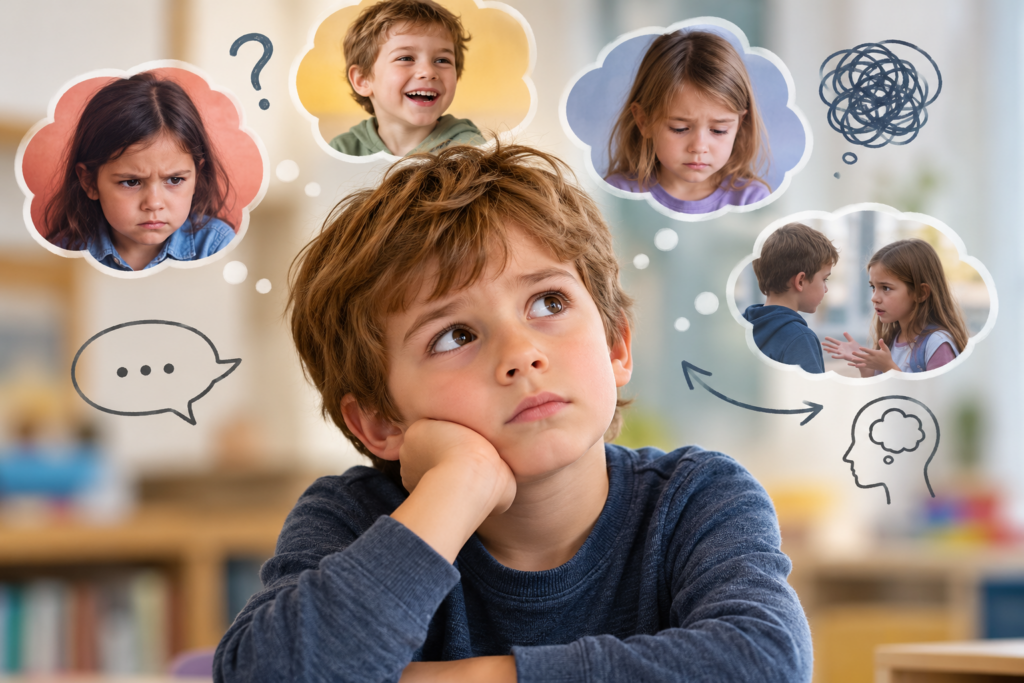
A child with developmental language disorder (DLD) may struggle to interpret tone of voice, explain why a peer became angry, understand another person’s intent, or put their own emotional state into words. Too often, these difficulties are treated as a separate “social” problem or immediately viewed as autism-like, while the child’s language disorder is discussed as though it has little to do with what is happening.
That separation is often misleading.
Emotional competence depends heavily on language. To understand an emotional situation, a child must process vocabulary, sentence meaning, tone of voice, implied meaning, perspective, context, and cause-and-effect relationships. To explain what happened, the child must then organize all of that information into language. When those systems are weak, emotional understanding can be affected as well.
This is not simply a clinical impression. Research increasingly shows that children with DLD can have meaningful difficulty recognizing, understanding, expressing, and regulating emotions.
The practical implication is important: social and emotional difficulties should not automatically be viewed as evidence of autism, nor should they be treated as unrelated to DLD simply because they appear “social” on the surface.
Emotional Competence Is Not Separate From Language
Emotional competence includes the ability to identify emotions, understand what causes them, recognize how another person is likely to feel, express one’s own emotional state, and regulate emotional responses in context.
All of these abilities place significant demands on language.
Consider an ordinary peer conflict. A child must follow what happened, understand the words that were used, notice tone of voice, distinguish an accident from a deliberate act, infer intent, understand what each person knew, interpret how each person felt, and explain what should happen next. That is not a simple “social skill.” It is a complex language task.
Children with DLD are often evaluated as though language begins and ends with vocabulary and grammar. It does not. Language is also the system children use to understand motives, make sense of emotions, interpret mental states, resolve ambiguity, and explain interpersonal events.
What the Research Is Showing
A large 2026 review looked across 42 studies examining emotional competence in children with language and learning disorders. Compared with typically developing children, these children had more difficulty recognizing emotions, understanding what emotions mean and why they occur, and expressing emotions effectively. The strongest differences were seen in emotion recognition and emotional understanding (Verdaguer-Ribas et al., 2026).
The findings on emotion regulation were less straightforward. In that review, children with language and learning disorders showed a tendency toward greater regulation difficulty, but the difference did not reach statistical significance. However, a separate 2026 review focused specifically on children and adolescents with DLD found significantly greater problems with emotion regulation compared with typically developing peers (Mateus-Moreno et al., 2026).
Taken together, the evidence does not suggest that every child with DLD will struggle to regulate emotions. It does suggest that emotional regulation is an important area of vulnerability for some children with DLD and should not be overlooked when concerns are present.
DLD Can Resemble ASD in Emotional and Social-Cognitive Tasks
Difficulty recognizing emotions is not unique to autism. Neither is difficulty understanding tone of voice, seeing another person’s point of view, or explaining why someone behaved or reacted a certain way. Children with DLD can struggle with all of these skills too.
That does not mean DLD and autism spectrum disorder (ASD) are the same. They are not. It also does not mean that children with DLD have the same overall social-emotional profile as children with ASD.
What the research does show is that the two groups can sometimes look very similar on specific tasks.
Taylor et al. (2015) found similar difficulties in autistic children with significant language impairment and children with specific language impairment, an older diagnostic term that overlaps substantially with what we now call DLD. Both groups had difficulty identifying emotions from faces and voices, including more basic emotions.
Löytömäki et al. (2020) also compared children with ASD, ADHD, and DLD who had difficulty recognizing emotions. Their performance was often quite similar, and all three groups generally had more difficulty than typically developing children.
The important point is that difficulty reading emotions, understanding another person’s perspective, interpreting tone of voice, or making sense of social situations should not automatically be treated as evidence of autism. These difficulties can also occur in DLD. A careful diagnosis has to consider the child’s full developmental and communication profile, not rely on one social or emotional weakness.
Seeing an Emotion Is Not the Same as Understanding It
One of the most important recent findings is that children with DLD may not have difficulty seeing facial expressions. The problem may be understanding what those expressions mean.
López-Penadés et al. (2026) found that children with DLD were less accurate than typically developing children when they had to name the emotion shown on a face. However, when they simply had to match similar emotional expressions, they performed just as well. Their language abilities and their ability to reason about other people’s thoughts and feelings were also related to how well they could label emotions.
A child may clearly see that two facial expressions are different but still struggle to identify the emotion accurately or explain what it means in context. The difficulty may come from weak emotion vocabulary, limited understanding of mental-state words, difficulty making inferences, or trouble connecting what they see with the language and context of the situation.
This is also why isolated emotion-identification tasks can be misleading. A child who can identify happy, sad, mad, and scared from a few photographs has demonstrated one narrow aspect of emotional understanding under highly structured conditions.
Real-life emotional understanding is far more demanding. A child may need to consider what was said, how it was said, facial expression, what happened beforehand, what each person knows, what each person may be thinking, and whether the speaker’s intent was serious, joking, sarcastic, accidental, or deliberately hurtful. All of that information has to be integrated, often within seconds.
Children with DLD may perform adequately on simple, explicit tasks and still struggle when emotional information is less direct. Tsou et al. (2023) found that children with DLD could improve or catch up on some explicit verbal emotion-understanding tasks over time while remaining more vulnerable when emotional meaning was implicit.
Being able to label an emotion correctly in a structured task does not necessarily mean that a child can interpret emotions accurately during a real conversation, peer conflict, classroom interaction, or complex social situation.
Why These Difficulties Matter in Real Life
These weaknesses matter because they affect participation.
Children and adolescents with DLD have been found to experience greater peer victimization, and emotional understanding appears to influence those outcomes (van den Bedem et al., 2018). Emotion recognition and anger dysregulation have also been shown to help explain the relationship between communication difficulties and reactive externalizing behavior (van den Bedem et al., 2020).
The mental-health literature also shows increased vulnerability to internalizing and externalizing problems in children with language and learning disorders (Ahufinger et al., 2025; Donolato et al., 2022).
These findings do not mean that DLD inevitably produces psychiatric disorder. They mean that the risk is real. A child who repeatedly misreads intent, fails to understand why others react negatively, cannot explain an internal state, or becomes dysregulated when language load increases may be experiencing a communication problem with significant functional consequences.
Emotional Competence Also Belongs in Literacy
These same difficulties can show up in academic work.
Reading comprehension requires much more than understanding the words on the page. Students must infer why characters behave the way they do, recognize changes in emotion, understand conflicting motives, interpret information that is implied rather than directly stated, and keep track of what different characters know, believe, or misunderstand. Writing draws on many of the same abilities.
Recent research has linked emotion vocabulary with reading comprehension and found meaningful relationships among emotional understanding, mental-state reasoning, and comprehension in struggling readers (Sabag-Shushan & Katzir, 2024; Sabag-Shushan et al., 2025).
For a child with DLD, a weak explanation of a character’s motivation, failure to notice an important emotional shift, or a written response that does not make sense socially should not automatically be treated as a separate “social skills” problem. These difficulties may be part of the child’s broader language and literacy profile.
In real academic tasks, oral language, pragmatics, emotional competence, reading comprehension, and writing work together. Weakness in one area can affect performance across several others.
Assessment Should Follow the Functional Complaint
A comprehensive language evaluation should examine emotional competence when the referral history includes peer problems, emotional misunderstandings, rigid interpretations, unexplained behavioral reactions, social-communication concerns, or difficulty interpreting interpersonal situations.
Relevant assessment targets may include:
- emotion vocabulary and distinctions among closely related emotional states;
- recognition of emotion from voice and prosody, not only static facial photographs;
- understanding of emotional causes, consequences, mixed emotions, and changes in emotion across events;
- verbal and contextual Theory of Mind, including what another person knows, believes, expects, intends, or misunderstands;
- narrative and pragmatic interpretation of motives, conflict, perspective, implied meaning, sarcasm, and ambiguity; and
- the child’s ability to identify and communicate internal states, together with functional information from parents, teachers, and the child.
The purpose is not to add another checklist to the evaluation. It is to determine whether language weakness is contributing to the child’s difficulty interpreting, expressing, or regulating emotion in real situations.
Treatment Should Match the Actual Difficulty
Treatment should be based on the specific difficulties identified during assessment.
For some children, that may mean building more precise emotional vocabulary. For others, it may involve interpreting tone of voice, explaining what another person may be thinking or feeling, making reasonable inferences, repairing misunderstandings, or analyzing interpersonal situations.
If a child repeatedly misreads conflict, treatment can help the child examine what was said, what was implied, what each person knew or intended, and whether more than one interpretation of the situation is possible.
If the difficulty appears in reading or writing, intervention should address it there as well. A child who misses emotional shifts, character motives, or changes in perspective needs practice interpreting those ideas in connected text, not only in isolated social-skills activities.
The work should be meaningful and connected to real situations. Repeatedly labeling emotions on cartoon faces is not enough. Children need supported practice with the language, texts, conversations, and interpersonal situations that are actually causing difficulty.
It is also important not to overstate what the treatment research currently supports. There is not yet strong evidence that any particular branded social-emotional program is an established treatment for DLD. Verdaguer-Ribas et al. (2026) noted that research on emotional interventions specifically adapted for children with language and learning disorders remains limited. The most defensible approach is to identify the skills that are genuinely weak and target those skills in functional contexts.
Significant anxiety, depression, severe emotional dysregulation, or other psychiatric symptoms require appropriate mental-health care. The SLP can address the language and communication demands contributing to the child’s difficulties while mental-health professionals address psychiatric symptoms. In many cases, the best care is collaborative.
The Clinical Takeaway
DLD is not “just language” because language is much more than vocabulary and grammar. It is one of the main tools children use to understand other people, make sense of emotions, interpret motives, handle conflict, understand stories, and explain what they are thinking and feeling.
Children with DLD are at increased risk for meaningful difficulties with emotional competence. Some of these difficulties can resemble what we see in autism, and on certain tasks children with DLD may perform at similar levels. That does not mean DLD and autism are the same. It means that difficulties with emotion, perspective taking, and social understanding are not unique to autism.
The better question is not, “Is this a language problem or a social-emotional problem?”
The better question is, “How is this child’s language profile affecting the way they understand, express, and regulate emotion in real situations?”
That question leads to more accurate assessment, clearer understanding of the child’s needs, and more targeted treatment.
References
Ahufinger, N., Aguilera, M., Guerra, E., Giberga, A., Verdaguer-Ribas, O., Balboa-Castells, R., Andreu, L., Esteve-Gibert, N., & Sanz-Torrent, M. (2025). Emotional suffering in school-aged children and adolescents with and without developmental language disorder. Acta Psychologica, 255, 104927. https://doi.org/10.1016/j.actpsy.2025.104927
Donolato, E., Cardillo, R., Mammarella, I. C., & Melby-Lervåg, M. (2022). Research review: Language and specific learning disorders in children and their co-occurrence with internalizing and externalizing problems: A systematic review and meta-analysis. Journal of Child Psychology and Psychiatry, 63(5), 507–518. https://doi.org/10.1111/jcpp.13536
López-Penadés, R., Esteller-Cano, À., Sanchez-Azanza, V. A., Aguilar-Mediavilla, E., & Adrover-Roig, D. (2026). Facial emotion recognition difficulties in children with developmental language disorder: A predominantly linguistic issue. Journal of Speech, Language, and Hearing Research, 69, 4912–4926. https://doi.org/10.1044/2026_JSLHR-25-00859
Löytömäki, J., Ohtonen, P., Laakso, M.-L., & Huttunen, K. (2020). The role of linguistic and cognitive factors in emotion recognition difficulties in children with ASD, ADHD or DLD. International Journal of Language & Communication Disorders, 55(2), 231–242. https://doi.org/10.1111/1460-6984.12514
Mateus-Moreno, A., Guirado-Moreno, J.-L., López-Penadés, R., Aguilar-Mediavilla, E., & Adrover-Roig, D. (2026). Emotion regulation in children and adolescents with developmental language disorder: A systematic review and meta-analysis. Child Development. Advance online publication. https://doi.org/10.1093/chidev/aacag141
Sabag-Shushan, T., & Katzir, T. (2024). Emotional understanding in reading comprehension at the text, task, and reader levels: A comparison of diverse struggling readers. Reading and Writing, 37(8), 1905–1929. https://doi.org/10.1007/s11145-023-10447-x
Sabag-Shushan, T., Katzir, T., & Kanat-Maymon, Y. (2025). The contribution of emotion vocabulary to the reading comprehension of the text and the task. Reading and Writing, 38, 2609–2632. https://doi.org/10.1007/s11145-024-10609-5
Taylor, L. J., Maybery, M. T., Grayndler, L., & Whitehouse, A. J. O. (2015). Evidence for shared deficits in identifying emotions from faces and from voices in autism spectrum disorders and specific language impairment. International Journal of Language & Communication Disorders, 50(4), 452–466. https://doi.org/10.1111/1460-6984.12146
Tsou, Y.-T., Wiefferink, C. H., Broekhof, E., & Rieffe, C. (2023). Short report: Longitudinal study on emotion understanding in children with and without developmental language disorder. Research in Developmental Disabilities, 137, 104493. https://doi.org/10.1016/j.ridd.2023.104493
van den Bedem, N. P., Dockrell, J. E., van Alphen, P. M., Kalicharan, S. V., & Rieffe, C. (2018). Victimization, bullying, and emotional competence: Longitudinal associations in (pre)adolescents with and without developmental language disorder. Journal of Speech, Language, and Hearing Research, 61(8), 2028–2044. https://doi.org/10.1044/2018_JSLHR-L-17-0429
van den Bedem, N. P., Dockrell, J. E., van Alphen, P. M., & Rieffe, C. (2020). Emotional competence mediates the relationship between communication problems and reactive externalizing problems in children with and without developmental language disorder: A longitudinal study. International Journal of Environmental Research and Public Health, 17(16), 6008. https://doi.org/10.3390/ijerph17166008
Verdaguer-Ribas, O., Ahufinger, N., March-Llanes, J., Moya-Higueras, J., Mayo, C., & Aguilera, M. (2026). Emotional competence in children with language and learning disorders: A systematic review and meta-analysis. Journal of Learning Disabilities. Advance online publication. https://doi.org/10.1177/00222194261491764